Another semester of Ballet has started and our bodies are failing us already. After a two week vacation until Fall session my legs have lost their strength again and my feet are as bad as when I started. And yet the movement is still somewhere in my memory: all those impossible rules that turn the body into a graceful instrument. The only requirement is to let the body mend itself slowly in every class. I know how Ballet works and most of it is plain stoicism. You let your hips turn out and ignore the pain, you stretch your back until it arches as much as possible, you warm up doing splits as you think about the music and ignore the volts of pain shooting from your muscles. Then you do Barre work and you remember were all those muscles you hadn’t been using had gone to, and you hate feeling them there. And despite the constant pressure on the ankles and the limpness of the arms, the body slowly awakens and it always comes back for more. There is something very noble in this type of suffering and I know that by the end of the week I will be turning pirouettes again, hopefully, I just don’t know how tired I will be physically.
But this short entry is to tell you a story my Ballet teacher, Mrs. Horne, told us as we were doing center work: It happened that half of the class was going too fast and the other half was moving too slow to the piano music. This infuriated Mrs. Horne, who hates sloppy dancing.
“I knew a Ballet teacher in the seventies.” She remarked, “Called Irma Vlansky. She was a beautiful dancer. Beautiful. She lived in Germany and got captured by the Nazi army one winter.”
Mrs. Horne seemed to be talking to herself now, but we all listened.
“They crushed her feet and tortured her, but she survived and exiled to the United States in where she taught Ballet in my studio. Irma was a great teacher. Great. She could never dance anymore after what happenned, but she wore bright red shoes all the time. They were heavy Mary Jane shoes that she would stomp loudly every time one of her students did not follow the rhythm.”
And here is when Mrs. Horne stared at us all with her cat eyes,
“Can you imagine Irma? Yelling and stomping her shoes like crazy? Because maybe I should start wearing red Mary Jane’s now.”
And I have no more to say about this tragic story but this: You should have seen us all move in unison to the piano music like if Irma Vlansky were there, watching us with her heavy red shoes on. You should have seen us.
Saturday, August 25, 2007


Sunday, August 19, 2007
Cocaine Blues
Maybe I haven’t mentioned this, but I work at a Deli in the south area of Charlotte now, were all the ridiculously rich people buy their ridiculously expensive sandwiches and salads every weekend. My co-workers tend to vary every month as people come and go in these types of jobs, but my favorites are two girls from Central America called Silvia and Susan who work with me in the afternoons, and two guys born and raised in North Carolina who have graduated from college and remain undecided about their careers, they are called Will and David and they help me in the evenings. As different as my co-workers are from one another, I seem to get along with all of them pretty well. I communicate in one language with the first set and in another language with the other. Although Silvia and Susana think that Will and David are lazy, while David and Will believe Silvia and Susana are extremely annoying, they all seem to like me a lot. As hard as it is to believe, there IS something that unites them all despite their disparate lifestyles, and this is Religion (yes, how peculiar.)
Silvia and Susana were raised Catholic in Latin America, witch means that they go to church every Sunday to avoid sin and they mention God a lot. Will and David are Methodists for what I know, and they don’t go to church as much but they also mention God a lot, only that in a different way. I’ll give you an example of how God is a constant presence in Will’s life.
Two weeks ago Will gave Mike, a guy who used to work at the Deli with us, one hundred dollars so that Mike would get him cocaine.
We all know over here that these transactions are usually based on trust, given that there is no receipt one can print out for the purchase of a bag of coke, or no specific manager one can complain to if the coke the dealer got you was bad. So Will had trusted Mike with his one hundred dollars and had expected his coke pretty soon.
But it happened that Mike got a better job as a waiter last week and quit the Deli without telling anybody. He left a cell number that got disconnected three days ago and, according to Will, it is impossible to locate him. Tonight as I was sweeping the floor I asked Will,
“So, did Mike ever get you what you paid him for?”
“No. I am so upset Carolina. I trusted Mike you know. It’s not like I have all this spare money or anything. He’s such a piece of dirt, leaving with my hundred dollars and not even responding to my calls.”
“Yeah, well, doesn’t he wait tables at Upstream now? Just go talk to him personally when he gets out of work.”
Will looks at me calmly and answers, “Nah, I don’t have the time Carolina. And I’m not upset anymore you know, I’m a believer, and I know that God will make him pay for this somehow.”
“Oh. Ok.”
I am left somewhat speechless and decide to change to subject, sending Will off to get me more French baguettes from the bakery. God will punish somebody who ripped you off from your cocaine purchase? C’mon! What else will God do for you Will, hook you up with a chick? Pay your car insurance? Turn bread into cocaine for you? And I guess that for some people it all comes down to having tons and tons of inexplicable Faith. So cheers to that.
Silvia and Susana were raised Catholic in Latin America, witch means that they go to church every Sunday to avoid sin and they mention God a lot. Will and David are Methodists for what I know, and they don’t go to church as much but they also mention God a lot, only that in a different way. I’ll give you an example of how God is a constant presence in Will’s life.
Two weeks ago Will gave Mike, a guy who used to work at the Deli with us, one hundred dollars so that Mike would get him cocaine.
We all know over here that these transactions are usually based on trust, given that there is no receipt one can print out for the purchase of a bag of coke, or no specific manager one can complain to if the coke the dealer got you was bad. So Will had trusted Mike with his one hundred dollars and had expected his coke pretty soon.
But it happened that Mike got a better job as a waiter last week and quit the Deli without telling anybody. He left a cell number that got disconnected three days ago and, according to Will, it is impossible to locate him. Tonight as I was sweeping the floor I asked Will,
“So, did Mike ever get you what you paid him for?”
“No. I am so upset Carolina. I trusted Mike you know. It’s not like I have all this spare money or anything. He’s such a piece of dirt, leaving with my hundred dollars and not even responding to my calls.”
“Yeah, well, doesn’t he wait tables at Upstream now? Just go talk to him personally when he gets out of work.”
Will looks at me calmly and answers, “Nah, I don’t have the time Carolina. And I’m not upset anymore you know, I’m a believer, and I know that God will make him pay for this somehow.”
“Oh. Ok.”
I am left somewhat speechless and decide to change to subject, sending Will off to get me more French baguettes from the bakery. God will punish somebody who ripped you off from your cocaine purchase? C’mon! What else will God do for you Will, hook you up with a chick? Pay your car insurance? Turn bread into cocaine for you? And I guess that for some people it all comes down to having tons and tons of inexplicable Faith. So cheers to that.
Saturday, August 18, 2007
Toward The Blue Peninsula
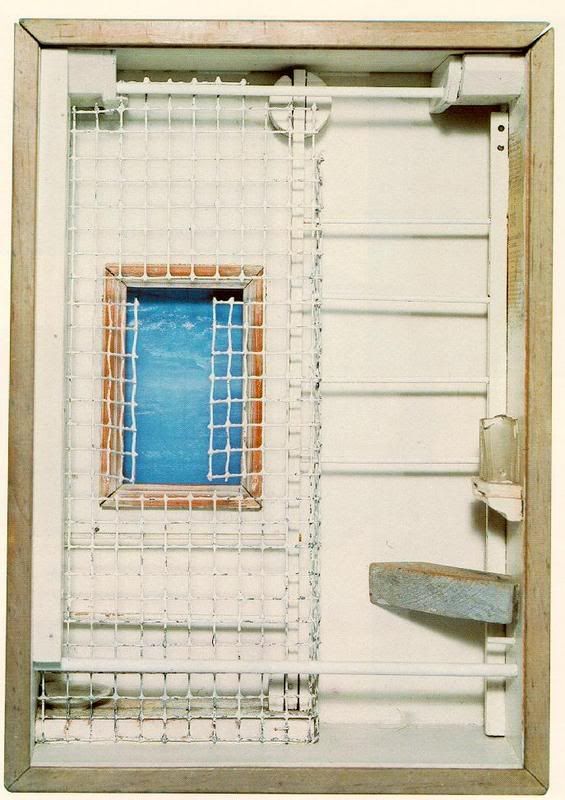
This is a piece by Joseph Cornell, an artist whose exhibit we went to see in Salem, Massachusetts (a five hour drive from NYC.) C has always liked Cornell’s art which takes place in a world inside boxes, and it was nice to watch him acting jumpy and excited to be there as he glided from room to room with a smile on his face. Rather than giving myself license to talk about Cornell’s work, I wanted to write about one box I enjoyed in particular; the one he dedicates to Emily Dickinson called “Toward the Blue Peninsula.” Cornell was as much of a loner as Dickinson was: one lived in Utopia Parkway, in Queens (a few blocks from where my parents live) and the other lived in Amherst, Massachusetts, both spent almost all their life reclused in rooms and inside the confinements of their imagination. Cornell, who liked to admire people from afar, ran into Dickinson’s picture one summer in a used bookstore he frequented daily.
Although they never met, I think what made Cornell obsess about her was the thought of Dickinson being alone in her room writing poems, because he could ultimately relate to that. Dickinson was always, always alone, to the point where she perceived herself as fluid and transitory, as unnoticed as the body of a bird (“I am nobody, who are you? Are you nobody too?”) So Cornell made her a box, and when one stares at it for too long one runs the risk of understanding its source, which is solitude, and of becoming Emily Dickinson for a few minutes or Joseph Cornell.
Some critics say that this box is like Dickinson’s room but if one looks closely it is also like a bird cage, except that the perch is empty. The bird is Emily Dickinson who has flown away in her imagination. And even though this opinion is valid, I might be able to understand it better through a dualist perspective: the soul flies like a bird with the wings of childhood plays, yes, but the loner Emily Dickinson is bound to remain in her cage for life. But even worse, if the body would ever find a way out of the cage and out of the room where it lies trapped, then the poor bird that is her imagination would disappear immediately, which is what happens when life and art fight against each other, and compromise daily.
I’ll just end this with something C told me about Cornell, on the drive back: “ On the day he died, he confessed to his sister that his only regret was that he had been so reserved all his life.” And who knows, maybe if Dickinson and Cornell would have met, if an extraordinary circumstance would have brought them together somehow, their lives would have been happier maybe. Then again, their art would have, probably, been very different from what it is.
Sunday, August 12, 2007
La Tregua
I cannot sleep, again, but you lie in bed breathing heavily after a long day’s journey into the night. I have been watching every Ballet variation I could find of “Esmeralda” in Youtube and my eyes keep following the movement under the soft radiation of the screen. I love gypsy music as it traces patterns in the air. My ears start to hurt by the thumping of those heavy Pointe shoes which are nailed to the floor, and by the tambourines.
Outside a fire alarm has gone on at two and I wonder if our Mexican neighbor is trying to make hamburgers, or if his “tent has burnt” again.
I have not told you about this, but I will probably get a minor in English next semester. I still like to study Philosophy, but there is no escape from this writing. I have tried. I have sold insurance for two years; I have offered many smiles to people for money, I have measured my life in coffee spoons. But it is only through art that I can redeem myself from the problem of Being, it is through this whip that God hands us.
I have to go to work in five hours, at the Deli.
I keep asking myself why rich people like terrible foods such as salmon or goat cheese on their salad, or organic eggs while me and the Latin girls would rather have grilled cheese sandwiches any day. Working class jobs are fun when I get to insult rich customers in Spanish and laugh along with the Latin girls. Working class jobs are not fun when half of your customers understand Spanish because they took it as an AP requirement to get into Duke. They also know French by the way, and German too. Working class jobs are not fun when rich customers ask you who your manager is so that they can complain to them about you, because you speak in Spanish in front of them and with the Latin girls too.
I will be in New York City in a few days, with you, and we will sleep inside museums and feed the ducks in Central Park. This is the way life should have been for us many years ago. We both deserve a break from the smoke, we deserve boxes of crystal figures and ice cubes, a treasure chest with a Ballerina’s picture inside it just like the one etherized inside the laminated pages of your book.
God hands you a whip, yes, but I have learnt that he also gives you a truce every once in a while. It is our turn to walk through the streets like blue flames
Outside a fire alarm has gone on at two and I wonder if our Mexican neighbor is trying to make hamburgers, or if his “tent has burnt” again.
I have not told you about this, but I will probably get a minor in English next semester. I still like to study Philosophy, but there is no escape from this writing. I have tried. I have sold insurance for two years; I have offered many smiles to people for money, I have measured my life in coffee spoons. But it is only through art that I can redeem myself from the problem of Being, it is through this whip that God hands us.
I have to go to work in five hours, at the Deli.
I keep asking myself why rich people like terrible foods such as salmon or goat cheese on their salad, or organic eggs while me and the Latin girls would rather have grilled cheese sandwiches any day. Working class jobs are fun when I get to insult rich customers in Spanish and laugh along with the Latin girls. Working class jobs are not fun when half of your customers understand Spanish because they took it as an AP requirement to get into Duke. They also know French by the way, and German too. Working class jobs are not fun when rich customers ask you who your manager is so that they can complain to them about you, because you speak in Spanish in front of them and with the Latin girls too.
I will be in New York City in a few days, with you, and we will sleep inside museums and feed the ducks in Central Park. This is the way life should have been for us many years ago. We both deserve a break from the smoke, we deserve boxes of crystal figures and ice cubes, a treasure chest with a Ballerina’s picture inside it just like the one etherized inside the laminated pages of your book.
God hands you a whip, yes, but I have learnt that he also gives you a truce every once in a while. It is our turn to walk through the streets like blue flames
Thursday, August 9, 2007
The Smoke
It gets so hard. So hard to move and breathe with this heat in North Carolina weighting me down. I stay here in the afternoons paralyzed by the thickness of the humidity, listening to my Mexican neighbor’s sad rancheras which he plays at high volumes in the dark of the night. Sometimes I wonder if my life would be the same anywhere else: here, in Buenos Ayres or in Havana, on the days when reality is as certain as three times three being five, or madness, or a dog.
My Mexican neighbor lives upstairs from us. Every night when I come back from work I see him sitting by himself in the balcony without his shirt on, listening to the radio, a set of Christmas lights hanging from the edge of the balcony even though it is August. And he waits for it to rain or maybe he just waits. There is nothing as painful as seeing him wait against a closed door in an open balcony in the dark of the night, with no lamp in a window and Christmas lights in August. Drink me to sleep tonight.
My Mexican neighbor lives upstairs from us. Every night when I come back from work I see him sitting by himself in the balcony without his shirt on, listening to the radio, a set of Christmas lights hanging from the edge of the balcony even though it is August. And he waits for it to rain or maybe he just waits. There is nothing as painful as seeing him wait against a closed door in an open balcony in the dark of the night, with no lamp in a window and Christmas lights in August. Drink me to sleep tonight.
Tuesday, August 7, 2007
When Smart People do Dumb Things
I am sitting at the reception of the Philosophy department, waiting for an appointment with Dr. Eldridge, my Ethics professor. His office door is open and I can hear his voice as it gets louder and louder in a debate with a student. This is when I begin to realize that I will probably have to wait for a long time given the nature of their discussion: Constructivist theory, but I am glad to be able to escape the heat of summer and I don’t mind killing some time under the air conditioner until the sun goes down. The department is small and one has to take into account that there are only thirty Philosophy majors in the entire school and no more than twelve Philosophy professors to teach us, so by one’s senior year it gets easy to know them all by name. Most of my former professors are hanging out in their offices this afternoon. Dr. Kelly who teaches Aesthetics is eating pineapple slices as he looks through the window, while Dr. Croy, my Logic professor, seems to be trying to fix the printer near the reception desk as Dr. Eldridge keeps on rambling from his office.
The receptionist, Jennifer, is a very sweet lady who takes care of these men’s bureaucratic matters, she is also the one who greeted me with a smile and asked me to take a seat. So I plan to spend at least thirty minutes of waiting time with my nose hidden inside a book, but after a few minutes, Dr. Croy’s complaints distract me:
“Jennifer, I can’t seem to get the printer to work! Do you think it is broken?”
“No Dr. Croy, you just have to hit the red button” answers Jennifer.
“The red button? and where is THAT?”
“To your left Dr. Croy, a red button”
I don’t think that Jennifer is willing to get up from her desk to help him, and I don’t think she should. Dr. Croy has a PhD. He has also published five books on Deductive Logic in the last two years and one would suppose that he is an intelligent man, so we both assume that he will eventually figure this problem out by himself, and find the red button. He keeps looking at the machine suspiciously though, and ten minutes later, Eureka!
“I just pressed the red button Jennifer, but nothing is happening, I think this printer is broken.”
Jennifer is smiling through her desk. “No, it’s not broken Dr. Croy, you just need to give it a minute because it needs to warm up.”
“Oh! Ok!”
A while later Dr. Croy finally made his photocopies. He kept staring at the machine and frowning at it though, his glasses moving up and down, like if this was his worst enemy. This incident brought me back to those evenings in class with Dr. Kelly, when he had to beg students to help him figure out how to use the remote control. Or to my mornings in class with Dr. Eldridge, who says that using markers instead of chalk on the board is the only technological advance he can handle. And I wonder how these men, so prestigious in Academia, manage to survive in the real world.
Smart people do very dumb things, you see. This is something I learned early in life. My mother has a Masters degree in Spanish but has to call my sister for help every time she accidentally logs out of the computer. My father got his Masters at UCLA but does not know how to change the oil of his car. Once, he even confused his parking lights with his brights and had been driving this way for months until my boyfriend noticed and pointed it out to him. My sister is a great artist, who cannot hold a job for more than two days due to her lack of people skills.
But I think that I am the dumbest of the family, I got electrocuted with our toaster once, after sticking a knife inside it to get my toast out faster. Three days later at breakfast, I stuck the knife again trying to get my toast out, and got electrocuted again. I think I was nineteen at the time, not eight.
I also got electrocuted once more, two years ago when I tried to cut a cable with a pair of scissors, except that the cable was plugged in to a switch. This incident made my sister start a series of studies regarding my IQ level which she titled: “Is My Sister Dummer than a Hamster?
Of course, at school I made straight A’s most of the time but that, honestly, said nothing to me about how smart I was when it came to practical matters.
Which is why I went to college I believe, same reason why Dr. Croy, Dr. Eldridge and Dr. Kelly seem to have gone to college: I was too dumb to do well in anything else which did not involve reading various texts or writing various papers about beautifully abstract matters. And the older I get, I come to understand that the reason why I would like to pursue a life in Academia and the reason why I enjoy to spend hours inside libraries, why sometimes I would rather read a book than be with people, is because I simply suck at doing everything else.
The receptionist, Jennifer, is a very sweet lady who takes care of these men’s bureaucratic matters, she is also the one who greeted me with a smile and asked me to take a seat. So I plan to spend at least thirty minutes of waiting time with my nose hidden inside a book, but after a few minutes, Dr. Croy’s complaints distract me:
“Jennifer, I can’t seem to get the printer to work! Do you think it is broken?”
“No Dr. Croy, you just have to hit the red button” answers Jennifer.
“The red button? and where is THAT?”
“To your left Dr. Croy, a red button”
I don’t think that Jennifer is willing to get up from her desk to help him, and I don’t think she should. Dr. Croy has a PhD. He has also published five books on Deductive Logic in the last two years and one would suppose that he is an intelligent man, so we both assume that he will eventually figure this problem out by himself, and find the red button. He keeps looking at the machine suspiciously though, and ten minutes later, Eureka!
“I just pressed the red button Jennifer, but nothing is happening, I think this printer is broken.”
Jennifer is smiling through her desk. “No, it’s not broken Dr. Croy, you just need to give it a minute because it needs to warm up.”
“Oh! Ok!”
A while later Dr. Croy finally made his photocopies. He kept staring at the machine and frowning at it though, his glasses moving up and down, like if this was his worst enemy. This incident brought me back to those evenings in class with Dr. Kelly, when he had to beg students to help him figure out how to use the remote control. Or to my mornings in class with Dr. Eldridge, who says that using markers instead of chalk on the board is the only technological advance he can handle. And I wonder how these men, so prestigious in Academia, manage to survive in the real world.
Smart people do very dumb things, you see. This is something I learned early in life. My mother has a Masters degree in Spanish but has to call my sister for help every time she accidentally logs out of the computer. My father got his Masters at UCLA but does not know how to change the oil of his car. Once, he even confused his parking lights with his brights and had been driving this way for months until my boyfriend noticed and pointed it out to him. My sister is a great artist, who cannot hold a job for more than two days due to her lack of people skills.
But I think that I am the dumbest of the family, I got electrocuted with our toaster once, after sticking a knife inside it to get my toast out faster. Three days later at breakfast, I stuck the knife again trying to get my toast out, and got electrocuted again. I think I was nineteen at the time, not eight.
I also got electrocuted once more, two years ago when I tried to cut a cable with a pair of scissors, except that the cable was plugged in to a switch. This incident made my sister start a series of studies regarding my IQ level which she titled: “Is My Sister Dummer than a Hamster?
Of course, at school I made straight A’s most of the time but that, honestly, said nothing to me about how smart I was when it came to practical matters.
Which is why I went to college I believe, same reason why Dr. Croy, Dr. Eldridge and Dr. Kelly seem to have gone to college: I was too dumb to do well in anything else which did not involve reading various texts or writing various papers about beautifully abstract matters. And the older I get, I come to understand that the reason why I would like to pursue a life in Academia and the reason why I enjoy to spend hours inside libraries, why sometimes I would rather read a book than be with people, is because I simply suck at doing everything else.
Monday, August 6, 2007
Childhood Bedroom
( I wrote this last semester as an assignment for my Creative Writing class, which happened to suck, but I might as well post it over here, somewhat lost in time.)
A few days ago I was flipping through the pages of a book titled “Post Secret,” which is a creative project that publishes postcards from people all over the United States with their secrets written on the back of them. One post card said “I hated my childhood bedroom,” and further down a collage had been put together by the sender, in where the picture of a sleeping bag had been cut and pasted inside the picture of a bathtub. “Wow” I thought as I imagined this poor man tucking himself in every night inside the tub, “He probably lived with twenty other people inside a small apartment.”
Who ever sent that postcard was, probably, somebody I could have related to at times, during my teenage years living outside of the city of Buenos Ayres, in Argentina and along with the other four members of my family. We all shared one bathroom and my childhood bedroom was the size of a small guest room, except that the ceiling was lower. It had two beds, mine and my sister’s, and whenever bored, we would jump in hopscotch from one bed to the other, except that one step was enough to make us land on any bed.
I must have mentioned the word “room” more than three times, but this narration is, really, about the lack of it. The only furniture we had were the beds and a night table placed in the center, so we had to improvise our interior designing skills on the walls instead. My sister, a future art student, used to build mobiles with threads that had colored marbles tied to the ends and would hang them close to the window so that the sun reflected on the marbles creating light spectacles, and for more decoration we used any postcard sent to us, any picture, which would get scotch taped to the walls. Soon the walls stopped being white as all of our friends kept smiling at us, their frozen faces trapped inside the pictures, along with those others we obsessed about but never knew: A picture of a young Robert Smith from “The Cure” on a corner, an Egyptian cat that reminded us of our own kitty, a Russian Ballerina posing in an arabesque on the corner.
Whatever we could not scotch tape to the walls, whatever magazine or book we owned, and whatever collection of articles left stacked in a pile, would go under the bed. Whatever did not fit under the bed, would be shoved inside the confinements of our closet. Inside the closet one could find the rarest articles: from a box filled with Barbie dolls with their eyes colored in markers, to old stuffed teddy bears and silver coins, to my mother’s wig she had to use while undergoing quimotherapy. My grandmother had decided to organize the closet for us once, so she took everything out and emptied it on our beds and for a week my room became a storage warehouse. I had to sleep surrounded by random childhood objects until we managed to organize some and throw away others. On those days I kept having dreams about living inside the glass displays of a museum and being trapped between hundreds of objects with the dense sentimental value that was attached to them like a thick glaze of glitter not being able to escape.
I cannot talk about privacy while I write about my childhood room, because if you wanted it, you would have to lock yourself inside the bathroom, hoping that no one else would get an urge to go or you would have to sit in the apartment hallway stairs for a while and try to finish your book in silence. My Dad would read the Bible in the bathroom for hours, for example, and my sister and I would have to call our boyfriends from the kitchen at three in the morning if we wanted to be alone.
Not to mention the heat inside that room: To relieve us from the humid summer temperatures of Buenos Ayres, we had a big electric fan that my sister and I would place in between our beds. The fan made a squeaky noise when on and it was rusted, but the rush of air felt pretty good, until after a few hours later when that air heated up and all we got back from the fan was more of the same hot air. On those nights it was impossible to sleep with the awful noises it made. Sometimes I would wake up soaked in my own sweat and hoping my sister would not notice, I would turn the fan to my side of the room so that it only faced me. I would get all the ventilation and fall asleep again, until a few hours later when I woke up soaked in my own sweat, again, finding out that the fan had been moved. My angry sister had taken revenge and moved it to her side of the room cutting out all the ventilation for me, and this is how the battle could last all night.
I recall many journal entries I wrote half awake on nights like that, with scribbled messages like this one. “March 26, Three AM: Woke up with a headache. Cannot go back to sleep because my sheets feel like they are melting. Took a shower and a sleeping pill. Felt better. Will try to go back to sleep with wet hair.”To keep this short I could agree with the postcard sender and say that I, too, disliked my childhood room, especially in summer. On certain nights, I seriously thought about placing a sleeping bag inside the tub and falling asleep in there, just like he seems to have done. But I am glad I grew up in my room now, because it makes me appreciate the space I have at the moment, even when it is not that much. The first condominium I rented with my family here in Charlotte was huge because I had a bedroom that was three times the size of my former room. I slept in a queen size bed and could not believe how immense it was. There was so much extra room that I had to leave my books on the corner, or invite my cat to sleep there too.
Now I currently live inside a “small” room with my own bathroom, in an apartment that I share with three other roommates, but everything is relative. I still believe my room is large enough to fit three more people, easily. We would just have to make a few arrangements though, like shoving my desk inside the closet and placing an inflatable mattress where the desk is, or making two people sleep in the queen size bed. Oh, and somebody would have to sleep in the bathtub maybe, but that would be just fine.
A few days ago I was flipping through the pages of a book titled “Post Secret,” which is a creative project that publishes postcards from people all over the United States with their secrets written on the back of them. One post card said “I hated my childhood bedroom,” and further down a collage had been put together by the sender, in where the picture of a sleeping bag had been cut and pasted inside the picture of a bathtub. “Wow” I thought as I imagined this poor man tucking himself in every night inside the tub, “He probably lived with twenty other people inside a small apartment.”
Who ever sent that postcard was, probably, somebody I could have related to at times, during my teenage years living outside of the city of Buenos Ayres, in Argentina and along with the other four members of my family. We all shared one bathroom and my childhood bedroom was the size of a small guest room, except that the ceiling was lower. It had two beds, mine and my sister’s, and whenever bored, we would jump in hopscotch from one bed to the other, except that one step was enough to make us land on any bed.
I must have mentioned the word “room” more than three times, but this narration is, really, about the lack of it. The only furniture we had were the beds and a night table placed in the center, so we had to improvise our interior designing skills on the walls instead. My sister, a future art student, used to build mobiles with threads that had colored marbles tied to the ends and would hang them close to the window so that the sun reflected on the marbles creating light spectacles, and for more decoration we used any postcard sent to us, any picture, which would get scotch taped to the walls. Soon the walls stopped being white as all of our friends kept smiling at us, their frozen faces trapped inside the pictures, along with those others we obsessed about but never knew: A picture of a young Robert Smith from “The Cure” on a corner, an Egyptian cat that reminded us of our own kitty, a Russian Ballerina posing in an arabesque on the corner.
Whatever we could not scotch tape to the walls, whatever magazine or book we owned, and whatever collection of articles left stacked in a pile, would go under the bed. Whatever did not fit under the bed, would be shoved inside the confinements of our closet. Inside the closet one could find the rarest articles: from a box filled with Barbie dolls with their eyes colored in markers, to old stuffed teddy bears and silver coins, to my mother’s wig she had to use while undergoing quimotherapy. My grandmother had decided to organize the closet for us once, so she took everything out and emptied it on our beds and for a week my room became a storage warehouse. I had to sleep surrounded by random childhood objects until we managed to organize some and throw away others. On those days I kept having dreams about living inside the glass displays of a museum and being trapped between hundreds of objects with the dense sentimental value that was attached to them like a thick glaze of glitter not being able to escape.
I cannot talk about privacy while I write about my childhood room, because if you wanted it, you would have to lock yourself inside the bathroom, hoping that no one else would get an urge to go or you would have to sit in the apartment hallway stairs for a while and try to finish your book in silence. My Dad would read the Bible in the bathroom for hours, for example, and my sister and I would have to call our boyfriends from the kitchen at three in the morning if we wanted to be alone.
Not to mention the heat inside that room: To relieve us from the humid summer temperatures of Buenos Ayres, we had a big electric fan that my sister and I would place in between our beds. The fan made a squeaky noise when on and it was rusted, but the rush of air felt pretty good, until after a few hours later when that air heated up and all we got back from the fan was more of the same hot air. On those nights it was impossible to sleep with the awful noises it made. Sometimes I would wake up soaked in my own sweat and hoping my sister would not notice, I would turn the fan to my side of the room so that it only faced me. I would get all the ventilation and fall asleep again, until a few hours later when I woke up soaked in my own sweat, again, finding out that the fan had been moved. My angry sister had taken revenge and moved it to her side of the room cutting out all the ventilation for me, and this is how the battle could last all night.
I recall many journal entries I wrote half awake on nights like that, with scribbled messages like this one. “March 26, Three AM: Woke up with a headache. Cannot go back to sleep because my sheets feel like they are melting. Took a shower and a sleeping pill. Felt better. Will try to go back to sleep with wet hair.”To keep this short I could agree with the postcard sender and say that I, too, disliked my childhood room, especially in summer. On certain nights, I seriously thought about placing a sleeping bag inside the tub and falling asleep in there, just like he seems to have done. But I am glad I grew up in my room now, because it makes me appreciate the space I have at the moment, even when it is not that much. The first condominium I rented with my family here in Charlotte was huge because I had a bedroom that was three times the size of my former room. I slept in a queen size bed and could not believe how immense it was. There was so much extra room that I had to leave my books on the corner, or invite my cat to sleep there too.
Now I currently live inside a “small” room with my own bathroom, in an apartment that I share with three other roommates, but everything is relative. I still believe my room is large enough to fit three more people, easily. We would just have to make a few arrangements though, like shoving my desk inside the closet and placing an inflatable mattress where the desk is, or making two people sleep in the queen size bed. Oh, and somebody would have to sleep in the bathtub maybe, but that would be just fine.
Friday, August 3, 2007
So, I think I can Dance
I’m really not trying to ridicule my dear boyfriend by adding three Ballet repertoires onto his Netflix list, plus two copies of “The American Ballet Theatre Workout, Level 2” and the movie “Billy Elliot” to be sent as soon as possible to our address, considering that everyone else online who looks at the list will assume that he is the one who’s into Ballet now, but I figured that he owes me one for that time he took goofy pictures of me with a fake mustache on, making me look exactly like Frank Zappa.
So this is to say that I started Ballet again this summer, after two years of not being able to do it, and I am incredibly happy to be dancing again.
The class is held twice a week at the Local Community College here in Charlotte, which makes the price very accessible for students, and it is taught by an old lady called Katherine Horne, who used to dance for the New York City Ballet at the time when George Balanchine was creating his best choreographies, and who yells at us a lot as she holds a cigarette between her fingers. The class is pretty diverse too: must of us used to dance in our teens and are trying to return to the Ballet world with these summer lessons, others are in their forties but can go on Pointe and jump better than the rest of us, a few are very advanced ballerinas, and the rest are guys believe it or not, who against any prejudice have fallen in love with this discipline.
It is hard to explain why some of us get addicted to this, but for me Ballet has always been about expressing a feeling in a language which does not use words, and the truth is that before I danced I had already fallen in love with the stories of the Ballet; magic fairy tales like Swam Lake and Fire Bird, Cinderella, Coppellia and the tragedies that were narrated through pantomime mimic. Taking Ballet is finding out that every joint in your body is there for a reason and that your legs were not only made for walking. In class, the body becomes a mere instrument that has to be polished to be later used in movement and polishing one’s movements is a never ending process that can take years.
Dancing has something very inhumane to it, if you want to put it that way, which has always attracted me towards it: The hips need to turn out against the will allowing one’s legs to open up into a fifth position, the arms rotate and the neck stays long as the spine remains straight. Wearing pointe shoes can lift us up from the ground as the center of gravity changes but it is completely unnatural for the foot to stay this way, and as painful as it feels, the reward we get is to be one step away from reality and higher off the ground, which comes to prove how much of a Stoic I am in my relationship to suffering.
I will write a Ballet entry once a week now, because I want to record my progress and failures, so you are all warned. Maybe after watching all these Dance movies together, I’ll be able to convince my boyfriend to start Ballet too. He already liked the “Billy Elliot” soundtrack at least!
So this is to say that I started Ballet again this summer, after two years of not being able to do it, and I am incredibly happy to be dancing again.
The class is held twice a week at the Local Community College here in Charlotte, which makes the price very accessible for students, and it is taught by an old lady called Katherine Horne, who used to dance for the New York City Ballet at the time when George Balanchine was creating his best choreographies, and who yells at us a lot as she holds a cigarette between her fingers. The class is pretty diverse too: must of us used to dance in our teens and are trying to return to the Ballet world with these summer lessons, others are in their forties but can go on Pointe and jump better than the rest of us, a few are very advanced ballerinas, and the rest are guys believe it or not, who against any prejudice have fallen in love with this discipline.
It is hard to explain why some of us get addicted to this, but for me Ballet has always been about expressing a feeling in a language which does not use words, and the truth is that before I danced I had already fallen in love with the stories of the Ballet; magic fairy tales like Swam Lake and Fire Bird, Cinderella, Coppellia and the tragedies that were narrated through pantomime mimic. Taking Ballet is finding out that every joint in your body is there for a reason and that your legs were not only made for walking. In class, the body becomes a mere instrument that has to be polished to be later used in movement and polishing one’s movements is a never ending process that can take years.
Dancing has something very inhumane to it, if you want to put it that way, which has always attracted me towards it: The hips need to turn out against the will allowing one’s legs to open up into a fifth position, the arms rotate and the neck stays long as the spine remains straight. Wearing pointe shoes can lift us up from the ground as the center of gravity changes but it is completely unnatural for the foot to stay this way, and as painful as it feels, the reward we get is to be one step away from reality and higher off the ground, which comes to prove how much of a Stoic I am in my relationship to suffering.
I will write a Ballet entry once a week now, because I want to record my progress and failures, so you are all warned. Maybe after watching all these Dance movies together, I’ll be able to convince my boyfriend to start Ballet too. He already liked the “Billy Elliot” soundtrack at least!
Subscribe to:
Posts (Atom)
